
Last updated: 27 May 2026 | 9617 Views |

Kate Chopin
A pioneering and subversive force in American literature who courageously unmasked the hidden landscapes of female desire, autonomy, and domestic oppression long before society was ready to listen.
Critical Acclaim
"A leader of American literature."
— Per Seyersted - a distinguished professor of American literature
"How did Kate Chopin know all this in 1899?"
Emily Toth - a professor of English and Women's Studies
Kate Chopin (1850-1904) stands as one of the earliest American trailblazers to depict female protagonists through themes that radically challenged the societal norms of her era. Her prose fearlessly navigated the domains of female sexuality, divorce, personal autonomy, extramarital liaisons, marital dynamics, and the systemic oppression of women enforced by religious institutions. Through her narratives, Chopin (โชแปง) meticulously explored the lives of women striving to forge a delicate equilibrium between their intrinsic desires and their mandated societal obligations. Her crowning literary achievement is the seminal novel The Awakening (การตื่นขึ้นของเอ็ดน่า) published in 1899 (2442). Over the course of her career, Chopin (โชแปง) penned more than one hundred short stories, which graced the pages of prestigious contemporary periodicals such as Vogue, Atlantic Monthly, Harper’s Young People, and The Century.
At the tender age of eighteen, when societal expectations dictated her formal debut into high society to secure a socially advantageous marriage, Chopin (โชแปง) expressed her profound disillusionment within her personal journals:
"All of this is profoundly tedious—I long for it to reach its conclusion... The endless cycle of parties, operas, concerts, ice skating, and festivities has consumed an immense portion of my time. The reading and writing that I so dearly cherish have been utterly abandoned." She further remarked with characteristic candor: "I find myself dancing with men whom I thoroughly despise, and feigning amusement with those whose sole merit resides entirely in their feet." Through these experiences, Chopin (โชแปง) mastered the artificial art of Victorian socialization, observing that: "Eloquence is by no means a necessity... one merely needs to govern the facial muscles to project an orchestrate display of pleasure, disappointment, surprise, or grievance—yet, under all circumstances, one must maintain an affectation of intense interest and amusement."
Chopin (โชแปง) entered matrimony at the age of twenty with Oscar Chopin (ออสการ์ โชแปง), giving birth to her first child a year later. During the sweltering summer months, she frequently journeyed with her children to Grand Isle (เกาะแกรนด์)—a sanctuary favored by the aristocracy seeking refuge from the seasonal outbreaks of cholera and yellow fever. She would later immortalize this very island as the atmospheric setting for The Awakening (การตื่นขึ้นของเอ็ดน่า). Within her marriage, her husband treated her as an intellectual equal and afforded her an uncommon degree of liberty. He remained uncritical of her penchant for smoking, drinking, horse riding, and her solitary excursions through the city or countryside. Furthermore, her elegant and avant-garde attire stood in stark contrast to the conservative sensibilities of the local women. During this period, Chopin (โชแปง) immersed herself in contemporary scientific discourse, deeply engaging with the transformative philosophies of Charles Darwin (ชาร์ลส์ ดาร์วิน: 1809-1882), Thomas Henry Huxley (โทมัส ฮักซ์ลีย์: 1825-1895), and Herbert Spencer (เฮอร์เบิร์ต สเปนเซอร์: 1820-1903).
At the age of thirty-nine, Chopin (โชแปง) embarked on her professional literary career, submitting her poetry to various magazines in 1889 (2432). Subsequently, she turned her attention to crafting short stories that captured the vibrant, localized textures of life in Southern Louisiana (ลุยเซียน่า), writing fluidly for both adult and youth audiences. Her short fiction achieved rapid commercial success, seamlessly aligning with the late 19th-century literary vogue for 'local color' regionalism. Yet, her work transcended the genre through its exceptional craftsmanship and a profound modernity that resonates powerfully to this day. Among her most celebrated short masterpieces are Désirée’s Baby (เดซีเรส์ เบบี) (1892), The Story of an Hour (เดอะ สตอรี ออฟ แอน เอาเวอร์) (1894), A Respectable Woman (อะ เรสเปกเทเบิล วูแมน) (1894), Athénaïse (อาเตเนส) (1895), and A Pair of Silk Stockings (อะ แพร ออฟ ซิลก์ สตอกกิงส์) (1896). These works were later anthologized in her critically acclaimed collections, Bayou Folk (บายู โฟล์ก) (1894) and A Night in Acadie (อะ ไนท์ อิน อาคาดี) (1897).
In 1897 (2440), Chopin (โชแปง) commenced the composition of The Awakening (การตื่นขึ้นของเอ็ดน่า). The novel centers upon Edna Pontellier (เอ็ดน่า ปองติเยร์), a wife and mother bound by domesticity who awakens to a profound realization of her own existential and sensual desires. Upon its publication in 1899 (2442), the novel was met with a torrent of hostile critical condemnation. Detractors denounced the work as "vulgar," "morbid," and "poisonous," deeming it utterly immoral and unfit for virtuous young women. Deeply wounded by this severe backlash, Chopin (โชแปง) retreated from the public eye, composing only a handful of short stories in her remaining years. Furthermore, her publisher, apprehensive of the explicit nature of her explorations of romance and human sexuality, refused to print any further anthologies of her work. Consequently, her third short story collection, A Vocation and a Voice (อะ โวเคชั่น แอนด์ อะ วอยซ์), remained unpublished until 1991 (2534)—eighty-seven years after her death.
Kate Chopin (เคท โชแปง) passed away on August 22, 1904 (2447) from a cerebral hemorrhage at the age of fifty-four. Her literary contributions languished in obscurity for decades until Per Seyersted (เพอร์ เซเยอร์สเต็ด), a distinguished professor of American literature, revived her oeuvre by publishing her collected works alongside a definitive biography in 1969 (2512), declaring her "a leader of American literature." In tandem, Emily Toth (เอมิลี ทอร์ธ), a professor of English and Women's Studies, reflected upon her own introduction to the author:
"I first read her work when a woman handed me a copy of The Awakening and told me, 'You must read this.' And the monumental question we must ask ourselves is: How did Kate Chopin know all this in 1899?"
It remains a profound tragedy that an author of Kate Chopin’s (เคท โชแปง) caliber departed this world without ever knowing that future generations would celebrate, revere, and scrutinize her words—ultimately recognizing her as a visionary writer who existed far ahead of her time.
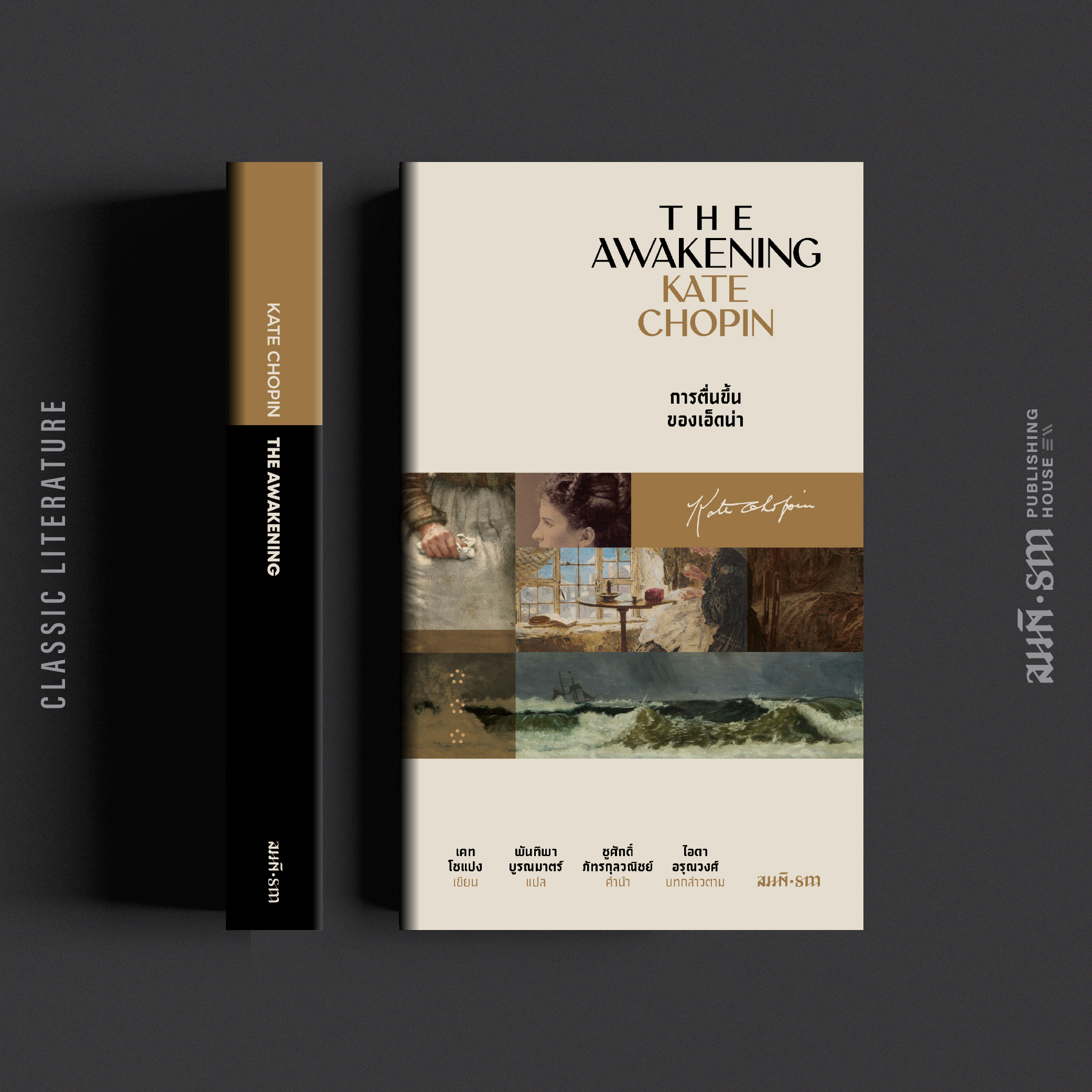
[Sommadhi Publishing House (สำนักพิมพ์สมมติ)] invites you to discover this immortal classic. Click here to read and purchase The Awakening (Thai Edition).

16 Sep 2022

3 Apr 2022

11 Feb 2022

26 Sep 2022