
Last updated: 27 May 2026 | 8177 Views |

Thomas Mann: One of the most monumental and influential German novelists of the 20th century, whose profound literary canvas masterfully chronicled the turbulent socio-political shifts of modernity.
"...Bear in mind that there is a power stronger than reason and goodness, and it will not easily allow anyone to resist its monumental authority..."
Thomas Mann (โธมัส มันน์), the laureate of the 1929 Nobel Prize in Literature for his masterpiece Buddenbrooks, lived through an era marked by some of the most radical socio-cultural and structural transformations in history. His life spanned the pivotal height of the Industrial Revolution, the unification and nation-building of Germany under Otto von Bismarck (อ็อตโต ฟอน บิสมาร์ก), the devastation and defeat of World War I, and the ultimate collapse of the German monarchy.
Born on June 6, 1875, into a wealthy patrician family, Mann showed absolutely no interest in the family business. Instead, both he and his elder brother, Heinrich Mann (หลุยส์ ไฮน์ริช มันน์), possessed an extraordinary literary talent and a shared passion for writing. Mann’s literary career began to crystallize with the publication of his debut short story, Gefallen (รักลวง), in the literary-political journal Die Gesellschaft. Deeply intellectual, Mann immersed himself in the seminal works of literature and philosophy, drawing profound inspiration from William Shakespeare (เชคสเปียร์), Theodor Fontane (ฟอนทาเน่อ), Friedrich Nietzsche (นิทเช่), Arthur Schopenhauer (โชเปน-ฮาวเออร์), and Sigmund Freud (ฟรอยด์).
In 1933, following the Nazi rise to power, Mann self-exiled to Switzerland as the regime began targeting dissidents through professional suppression and existential threats. He was subsequently stripped of his honorary doctorates, deprived of his citizenship, and blacklisted by the secret police. Although his early ideological inclinations were largely conservative, Mann possessed the intellectual honesty and moral courage to rectify his past views, standing firmly in defense of human liberty, civil rights, and democratic governance. After fleeing Europe, Mann obtained American citizenship in 1940 and settled in Santa Monica (แซนตา มอนิกา), California (แคลิฟอร์เนีย). Following the end of the war, he regularly traveled back to Europe. In 1949, he was honored with the Goethe Prizes of both Weimar (East Germany) and Frankfurt (West Germany). In the twilight of his life, he returned permanently to Europe, residing in Zurich (ซูริก) until his passing from thrombosis in 1955.
Critical Acclaim for the "20th-Century Goethe"
International media and literary critics have long cemented Mann’s legacy with monumental praise:
Featured Work: Mario and the Magician (Thai Edition)
As a brilliant novella by the writer dubbed the "Goethe of the 20th Century," Mario and the Magician (มาริโอกับนักมายากล) serves as a remarkably sophisticated satire against extreme nationalism. This exceptional narrative encapsulates the core of Thomas Mann’s political philosophy.
The allure and enduring value of this novella extend far beyond its political subtext; it seamlessly encapsulates the profound socio-historical milieu of its time. Although Mann once casually referred to the piece as a mere travelogue or a diary entry from a family vacation, a meticulous reading between the lines unveils an undeniable, sharp critique of fascist nationalism.
The central existential dilemma posed by Mann in this work is profound: When human free will is systematically subjugated, how do we break free from the spell? If the reality before our eyes mirrors the grand illusion performed on a magician's stage, the audience is already conditioned to accept it merely as a "performance."
Few ever realize that they are under mass hypnosis. In Mario and the Magician, Thomas Mann vividly illustrates the anatomy of psychological manipulation, rendering the taste of "free will" as something simultaneously bittersweet and profound. The psychological and ideological tension between the protagonist Mario (มาริโอ) and the hypnotist Cipolla (ชิปอลล่า) remains an intellectual battleground that challenges and provokes readers to this day.
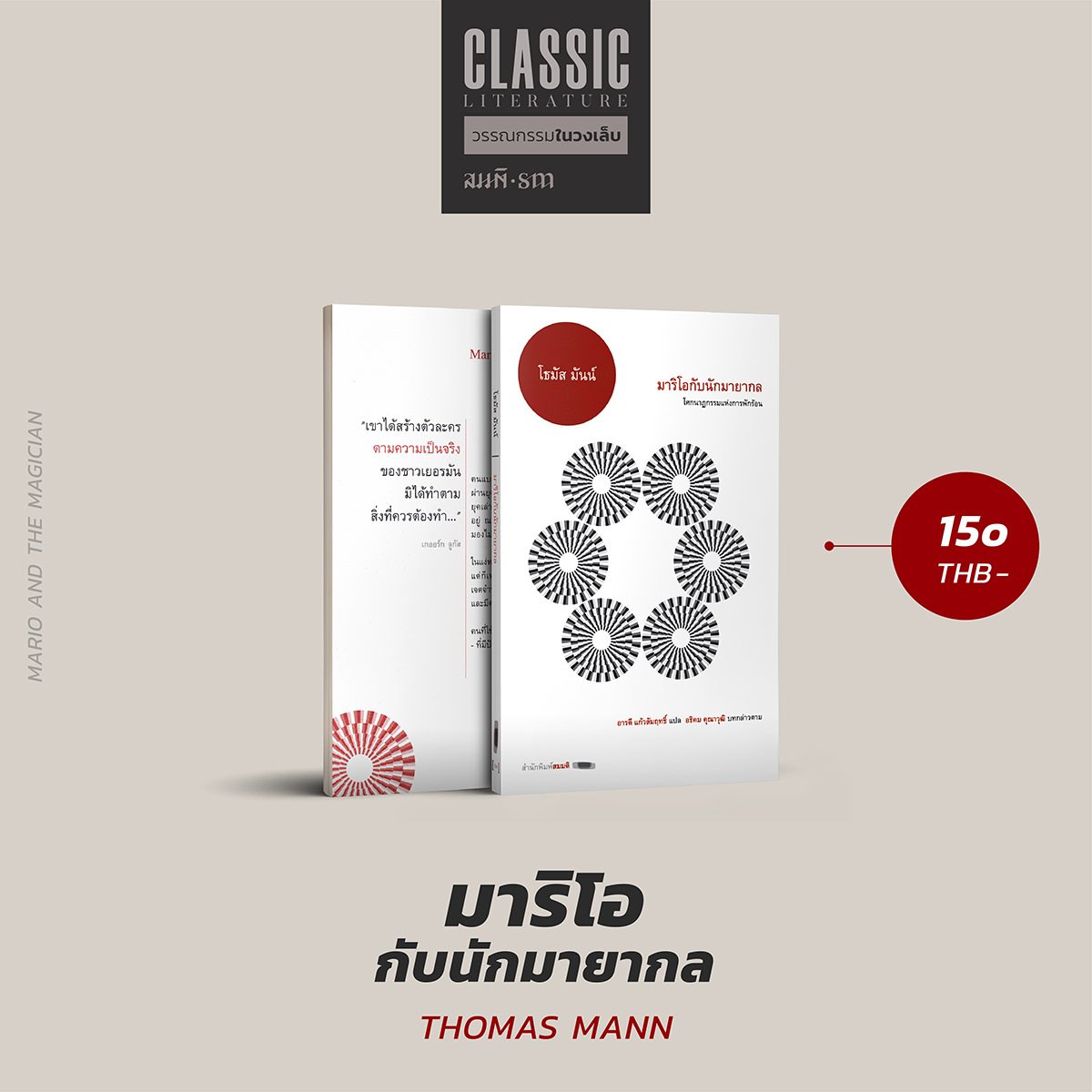
Order Mario and the Magician (Thai Edition)
Published
by Sommadhi Publishing House (สำนักพิมพ์สมมติ)


3 Apr 2022

11 Feb 2022

16 Sep 2022

26 Sep 2022