
Last updated: 2 Oct 2026 | 9380 Views |

Virginia Woolf stands as a towering pillar of literary modernism whose pioneering stream-of-consciousness narratives elegantly forge enduring cosmic order from the devastating chaos of human existence and mortality.
Regarded as one of the most formidable female icons of the modernist epoch, Virginia Woolf has long served as a profound locus of inspiration for legendary authors such as Gabriel García Márquez and Margaret Atwood. Born Adeline Virginia Stephen in 1882, she was raised within the upper-middle class of a decidedly conservative Victorian era. Like many foundational modernist authors, Woolf found herself in a perpetual dialogue with her own past—simultaneously drawing from it as a fertile creative wellspring while aggressively striving to sculpt entirely new forms from its traditional ruins.
Her father, Sir Leslie Stephen , was a distinguished literary critic and the founding editor of the Dictionary of National Biography. Her mother, Julia Jackson Duckworth Stephen , was a celebrated beauty well-connected within elite artistic and literary circles. Together, they raised eight children, spending idyllic, sun-drenched summers in the coastal town of St Ives in Cornwall—a setting that would later serve as the architectural and emotional blueprint for the Ramsay family’s summer home in her masterpiece, To the Lighthouse (ทู เดอะ ไลท์เฮาส์).
However, this idyllic youth was shattered when Julia died suddenly when Woolf was merely thirteen. Woolf would later characterize this loss as “the greatest tragedy that could possibly have happened in my life.” This initial trauma was compounded by a succession of familial grief: the sudden death of her half-sister Stella (สเตลล่า) shortly after marriage in 1897; her father's succumbing to cancer in 1904; and the untimely death of her brother Thoby from typhoid fever in 1906.
These consecutive encounters with mortality exerted a profound and lasting impact on Woolf’s psychological well-being and her subsequent creative output. The ultimate outbreak of World War I further magnified the omnipresence of death, rendering conventional, linear plots entirely obsolete in the face of such widespread devastation. Driven by this existential crisis, Woolf felt compelled to innovate entirely new narrative structures. Paradoxically, she composed To the Lighthouse as both a deeply personal elegy to her late parents and a final, collective mourning for the vanished Victorian epoch.
The Search for Order in Chaos
Woolf’s oeuvre is consistently animated by a rigorous impulse to discover symmetry and order when confronted with terrifying chaos. Her characters continuously strive to cultivate meaningful connections and capture ephemeral, transcendent moments.
Aligned with the philosophical ethos of the Bloomsbury Group (กลุ่มบลูมสเบอร์รี)—the avant-garde collective of writers and intellectuals in London to which she belonged—Woolf conceptualized art as a vital vehicle for genuine, often wordless communication, a necessary balm for the inherent incompleteness of human life.
"The relentless striving to 'make the moment permanent'—as Lily and Mrs. Ramsay attempt to do—remains the singular, noble endeavor available to humanity."
Featured Masterwork for Global Distribution & Translation
Novel: To the Lighthouse (Thai Edition)
A cornerstone of global modernism, this critically acclaimed edition offers international readers a beautifully curated translation of Woolf's profound meditation on time, grief, and the enduring power of art. Highly recommended for international literary collections and scholarly partnerships.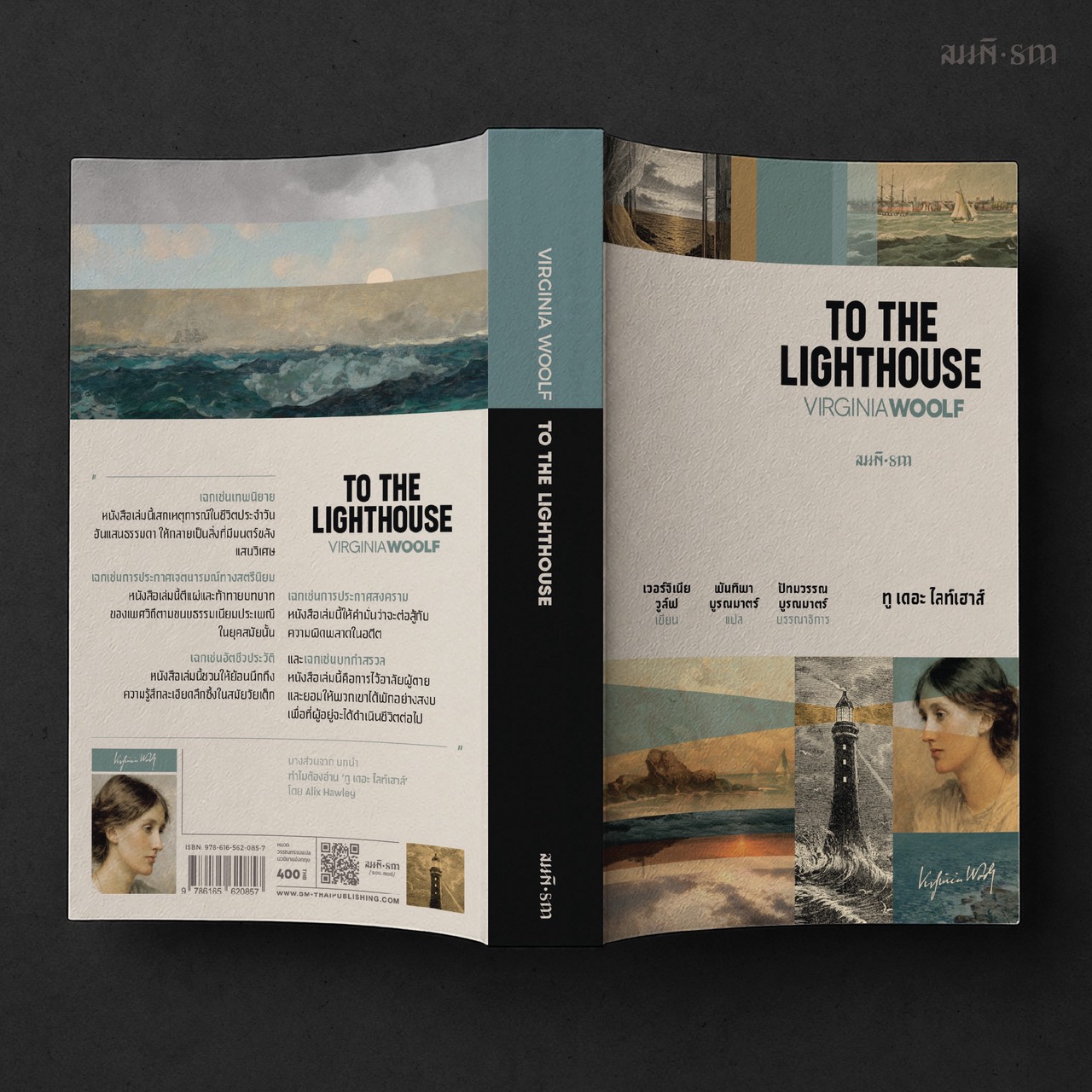
Order To the Lighthouse (Thai Edition)


3 Apr 2022

26 Sep 2022

16 Sep 2022

11 Feb 2022