
Last updated: 27 May 2026 | 8997 Views |

John Ruskin stands as one of the most monumental art, architectural, and social critics of the nineteenth century, whose profound philosophies intertwine aesthetic beauty with the moral fabric of human life.
John Ruskin is widely celebrated as one of the most formidable critics of art, architecture, and society of the Victorian era. In his youth, Ruskin was a solitary and deeply introspective child who avoided social circles, dedicating himself instead to rigorous reading, strict scriptural study, and composing essays on nature and architecture. He possessed a remarkable talent for watercolor and draftsmanship—an essential creative toolkit that allowed him to meticulously sketch and record historical architectural landmarks during his extensive travels.
Ruskin frequently extolled the sublime beauty of landscape paintings rendered by the seventeenth-century Italian and Dutch masters. Crucially, he did not view these works merely as passive scenery; rather, he examined them through the analytical lenses of a geologist and a botanist, perceiving the vital, spiritual interconnectivity of the natural world. This foundational perspective defined his approach as an art critic: he firmly rejected the superficial evaluation of art based solely on color, form, or commercial value, insisting instead that true art must reflect its broader social and environmental contexts.
To date, two of Ruskin’s seminal works have been translated into Thai:
On Art and Life (ว่าด้วยศิลปะและชีวิต)
Unto This Last (อันทู ดิส ลาสต์)
Key Works Available for Translation & Distribution
1. On Art and Life (ว่าด้วยศิลปะและชีวิต)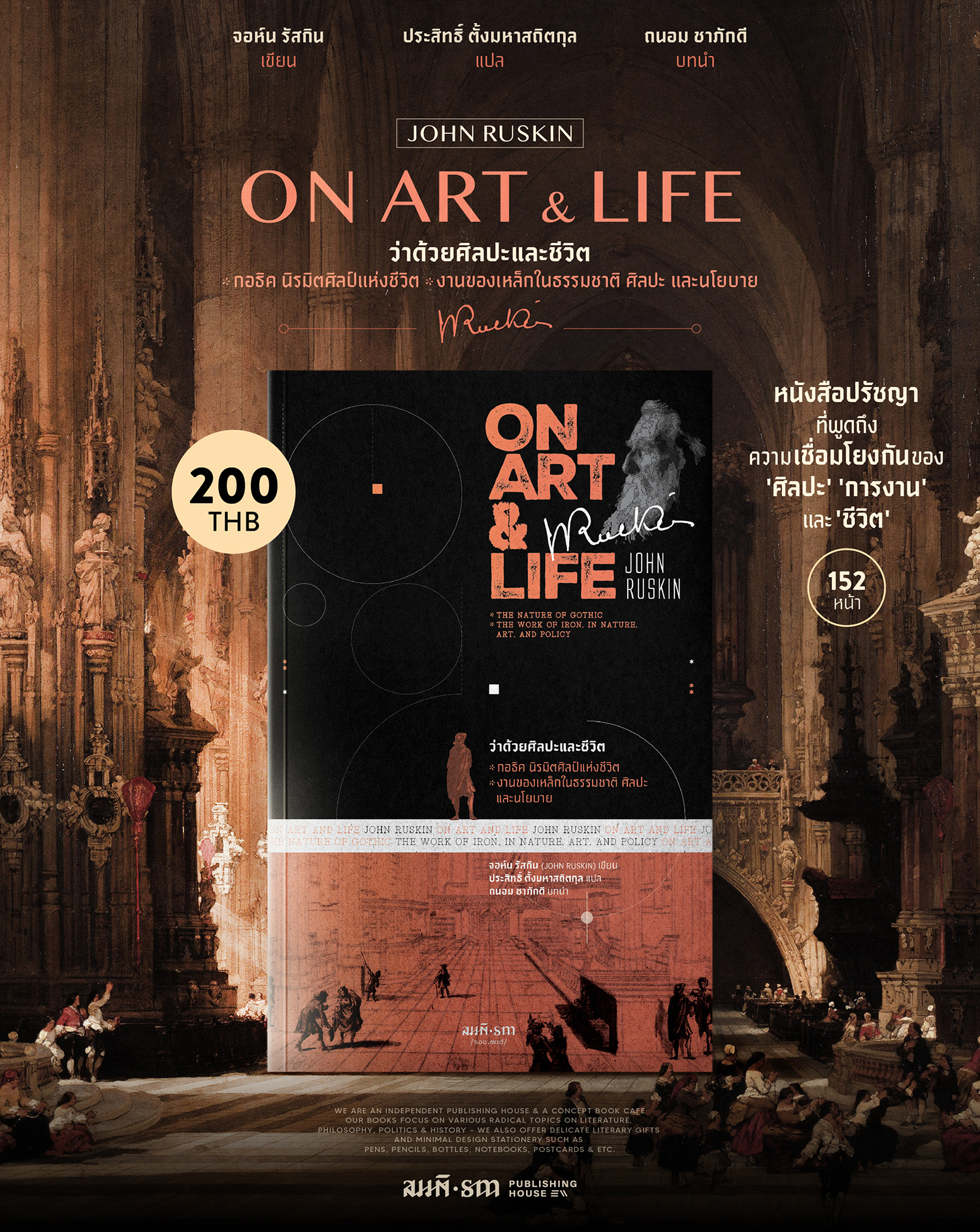
This volume compiles two essential essays exploring the profound relationship between aesthetic depth and the grace of human existence.
"The Nature of Gothic" (กอธิค นิรมิตศิลป์แห่งชีวิต): Extracted from his masterpiece The Stones of Venice, this essay dissects the history and unique characteristics of Gothic art, seamlessly connecting structural craftsmanship to the labor and spiritual life of humanity.
"The Work of Iron, in Nature, Art, and Policy" (งานของเหล็กในธรรมชาติ ศิลปะ และนโยบาย): An insightful treatise examining the attributes of iron as a natural element and its relationship to human civilization, while offering a searing critique of the Industrial Revolution.
"These essays grant readers a taste of the rhetorical mastery and critical rhythm of this renowned Victorian voice. Crucially, they open a gateway to an approach to art criticism that stands distinct from the thinkers of continental Europe." > — Thanom Chapakdee (ถนอม ชาภักดี), Excerpt from the Introduction
2. Unto This Last (อันทู ดิส ลาสต์)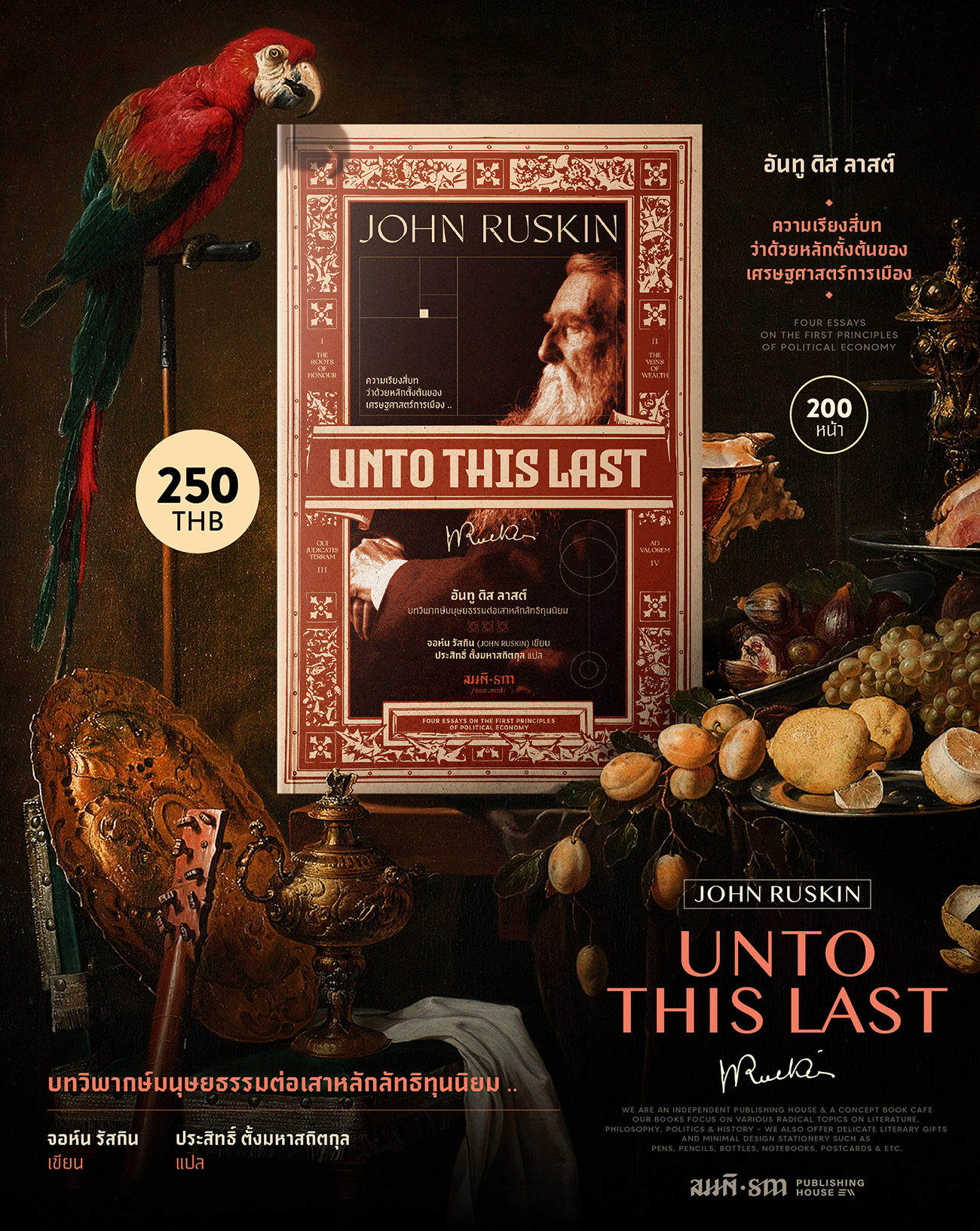
Considered by Ruskin himself to be his finest and most valuable intellectual achievement, this work stands as a monumental humanitarian critique of the foundational pillars of capitalism.
Marking its first-ever translation into the Thai language, the book directly challenges the political economy of John Stuart Mill (จอห์น สจ๊วต มิลล์) and the concept of Homo economicus (มนุษย์เศรษฐกิจ). Ruskin fiercely argues against the notion that society benefits from individual greed and materialist self-interest, asserting instead that moral integrity and human virtue form the true bedrock of any civilization. Reading this text not only clarifies the historical trajectory of economic thought but also offers a profound philosophy for cultivating a balanced, equitable society.
Special Collections
For institutions and readers seeking a comprehensive engagement with these philosophical frameworks, the publisher offers curated editions:
The Ruskin Collection


26 Sep 2022

16 Sep 2022

11 Feb 2022

3 Apr 2022