Last updated: 27 May 2026 | 6429 Views |

Isak Dinesen
a monolithic figure of twentieth-century literature whose profound narrative mastery twice brought her to the precipice of the Nobel Prize.
“Fear God, and dread nought else. Do not shrink from the flights of your imagination, and when you stand before two paths, choose the unfamiliar, the perilous—and may you be endowed with courage.”
— Isak Dinesen
She was a writer who rightfully merited the Nobel Prize in Literature in 1959—the very year Graham Greene, John Steinbeck, and Salvatore Quasimodo were also nominated. Anders Österling, a prominent member of the Nobel Committee, championed her as the foremost candidate for that year's accolade. He urged that if this seventy-four-year-old matriarch of letters were to be honored, it must be done without delay.
While two other committee members concurred, a dissenting voice argued instead for the Italian poet Salvatore Quasimodo. The objection was rooted in geopolitics rather than aesthetics: Scandinavian authors had already claimed the prize four times, disproportionately outnumbering other nations. Ultimately, the 1959 Nobel Prize in Literature was bestowed upon Quasimodo.
While known to American and global readers as Isak Dinesen (ไอแซค ไดนีเสน), this was the celebrated nom de plume of Karen Blixen. Born on April 17, 1885, her childhood aspirations were anchored in the visual arts. However, her subsequent departure for Africa forced those artistic dreams into the recesses of her memory. Literary genius ran in her veins; her father, Wilhelm Dinesen, was a writer deeply revered by the Danish public, while her mother, Ingeborg Westenholz, hailed from a prominent merchant family and was the daughter of a Minister of Finance.
The Genesis of a Masterpiece
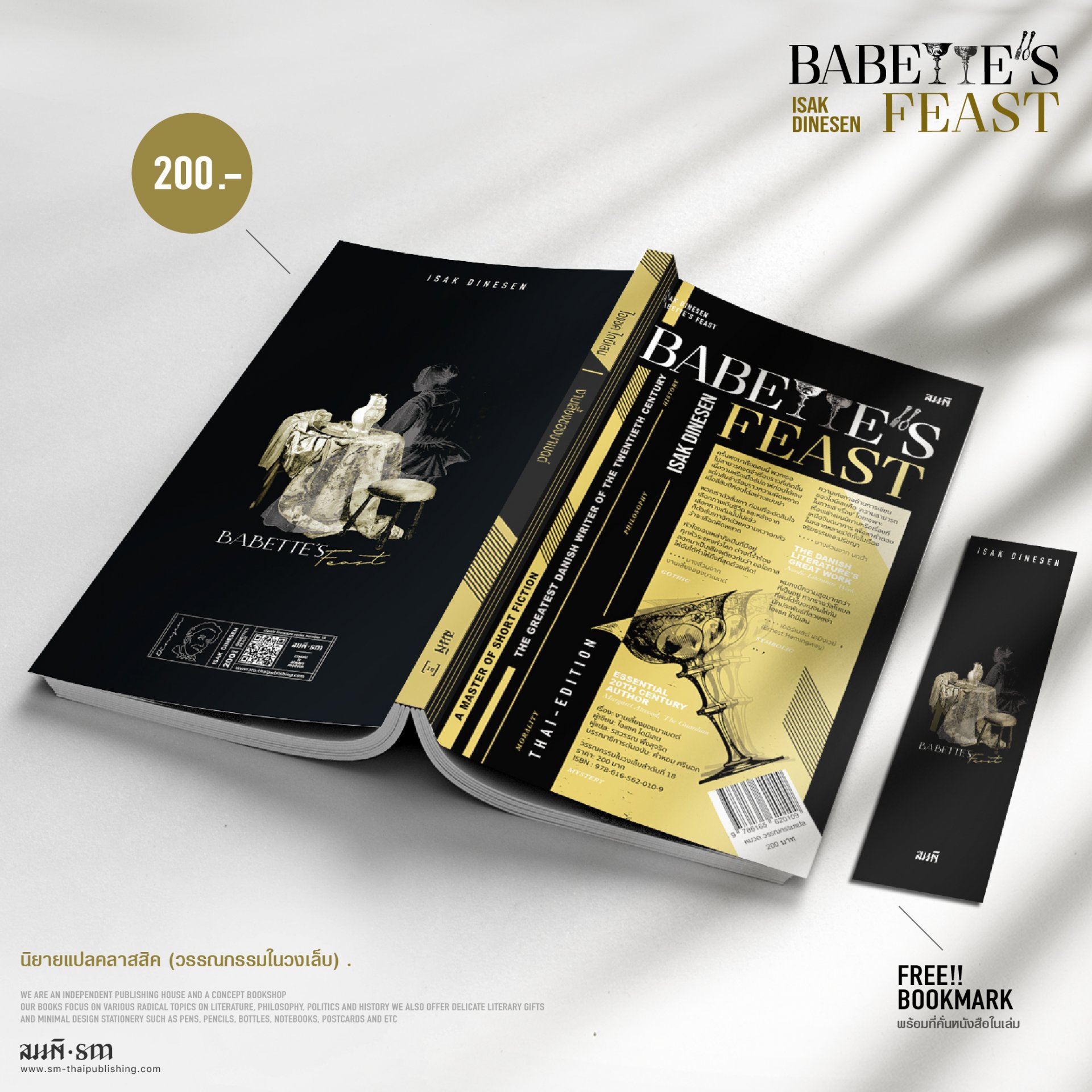
Her celebrated novella, Babette's Feast (งานเลี้ยงของบาเบตต์), conceived from a playful wager with a friend. As Judith Thurman notes in her definitive biography of Dinesen, a companion had challenged her ability to secure a publication in the prestigious American periodical The Saturday Evening Post. Dinesen accepted the challenge but was initially at a loss for a subject that would resonate with the American market.
Her friend suggested "food," noting the American preoccupation with culinary culture. This became the catalyst for Babette's Feast. On the surface, this short novel offers an enchanting and delightful narrative; yet, when read with critical depth, it unveils profound commentaries on European history, the true essence of artistry, the labyrinth of the human psyche, and profound theological undercurrents. Indeed, critics and academics alike have frequently likened the titular evening feast to the symbolic weight of The Last Supper.
A Legacy Carved in Time
In 1985, universities across Copenhagen united to celebrate the centenary of Karen Blixen’s birth. That same year, her former homestead within her coffee plantation in Kenya was consecrated as a national museum. By 1991, the Karen Blixen Museum in Copenhagen was fully realized—a testament to the enduring stature of a woman who once abandoned writing to seek a visceral life in Africa, only to dedicate the final three decades of her existence entirely to her craft upon returning to Denmark.
This twilight era of her life can be described as a period of pure, unadulterated literary devotion. Her monumental significance to her homeland is permanently etched into Danish culture: her visage graced the 50 Danish Krone banknote, and her legacy remains immortalized on national postage stamps.
Perhaps her impact is best encapsulated by Ernest Hemingway (เออร์เนสต์ เฮมิงเวย์), who, upon accepting his own Nobel Prize in Literature in 1954, magnanimously declared:
"I would have been happier today if the prize had been given to that beautiful writer Isak Dinesen."


11 Feb 2022

26 Sep 2022

3 Apr 2022

16 Sep 2022