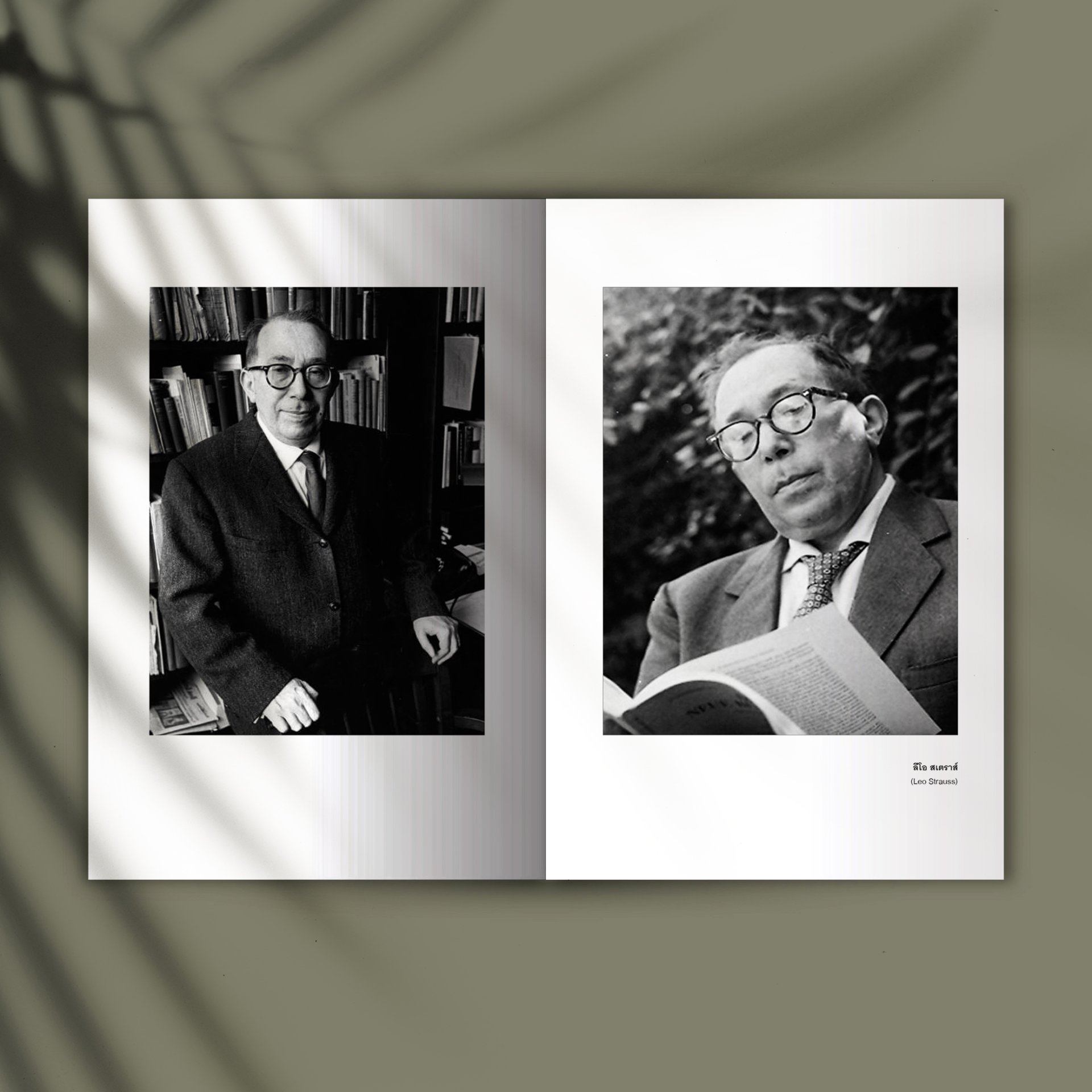
Ancients vs. Moderns. A definitive survey of Leo Strauss’s political thought, exploring the 'esoteric' art of reading and the quest to save liberal democracy from its own mediocrity.
Categories : Non-Fiction , FLASH SALE , Sale BookfairOnline , 300 THB ,
Share
A Survey of Leo Strauss’s Political Philosophy
By Attasit Sittidumrong
Introduction By Sombat Chantarawong
A Warning:
Those who disdain the tyranny of the majority must read this.
Those enamored with liberal democracy find it an even more vital necessity.
And for those caught in the ambiguity of the "undecided"—this work is written for you most of all.
Attasit Sittidumrong invites readers to navigate the profound intellectual landscape of Leo Strauss. A philosopher steadfastly committed to the "philosophic way of life," Strauss proposed a radical remedy for the inherent weaknesses of liberal democracy when confronted with the perils of majoritarianism.
Strauss remains a provocative figure for his revival of the "Quarrel between the Ancients and the Moderns." Choosing to stand with the former, he argued that classical thinkers possessed a moral and political science far superior to the relativism of the modern age. His work mirrors the pedagogical style of the ancients: avoiding direct pronouncements in favor of a layered discourse that demands interpretation. He famously bifurcated teachings into two distinct modes:
Exoteric Teaching: The public, accessible message.
Esoteric Teaching: The "hidden" or "secret" doctrine intended for the initiated.
"It is safer to try to understand the low in the light of the high than to understand the high in the light of the low."
This maxim encapsulates the Straussian essence. A Jewish-German emigré, Strauss was a master of the classical canon, meticulously examining the works of Plato, Aristophanes, Thucydides, Xenophon, Maimonides, Al-Farabi, Machiavelli, Hobbes, Spinoza, and Nietzsche. He revitalized the study of classical political philosophy—historian Sombat Chantarawong credits Strauss with single-handedly resurrecting the scholarly relevance of Xenophon.
In the Thai academic context, while Sombat Chantarawong pioneered Straussian thought, Attasit Sittidumrong carries the torch forward. Attasit reminds us that a philosopher’s words are not mere signs, but the "blood, flesh, and soul" that construct a world before the reader’s eyes. For Attasit, this survey is not just a study; it is a profound testament to the power of the written word.
// Table of Contents //
Acknowledgments
Introduction: Leo Strauss and Political Philosophy | By Sombat Chantarawong
Chapter 1: From the Philosophic Way of Life to the Life of Liberal Democracy: An Introduction to Reading Leo Strauss
Chapter 2: From the Death of Democracy to the Death of Modernity: Leo Strauss and the Transformation of Political Problems into Philosophic Problems
Chapter 3: Searching for the Past: Leo Strauss, the Return to Origins, and the Discovery of Ancient Reason in Greek (Political) Philosophy
Chapter 4: Philosophy in Conflict: Leo Strauss’s Resistance to Behavioralism and the Reclaiming of Educational Space for Political Philosophy
Chapter 5: Conclusion: Leo Strauss, the Defense of Democracy, and Persistent Dilemmas
Details
▪️Format : Paperback
▪️Piyavit Tepumnuaysakul : Editor
▪️Designed by ● SM STUDIO | ●
▪️Published : July 2015
▪️Length : 360 pages
▪️ISBN : 978-616-7196-39-8
▪️Dimensions (in) : 5.25 x 8.25
▪️Price : 300 THB