
Last updated: 24 May 2026 | 15278 Views |

H. G. Wells: A visionary titan of modern letters who systematically redrew the boundaries of the human imagination, pioneering contemporary science fiction as a profound laboratory for socio-political critique.
Herbert George Wells, universally revered as H.G. Wells (1866–1946), was a prolific English author whose extraordinary legacy spans over one hundred works, encompassing short stories, novels, essays, and non-fiction.
He is most celebrated globally for his foundational science fiction masterpieces, including The Time Machine (เดอะ ไทม์ แมชชีน), The Invisible Man (มนุษย์ล่องหน), and The War of the Worlds (สงครามผ่านเวหา), many of which have been adapted into legendary cinematic landmarks.
The Father of Contemporary Science Fiction
Wells is rightfully hailed as the "Father of Contemporary Science Fiction" (บิดาของนวนิยายวิทยาศาสตร์ร่วมสมัย). While he shared his era with another titan of the genre, Jules Verne (จูลส์ เวิร์น: 1828–1905), Wells fundamentally distinguished himself by crafting socio-political science fiction. He seamlessly wove his personal ideological perspectives and cultural critiques into his narratives.
In contrast to Verne—who diminished socio-political dimensions to focus heavily on intricate technological complexities—Wells imbued his narratives with a starkly superior depth of humanism. His characters, while operating within speculative frameworks, remain profoundly grounded, exhibiting a far less nihilistic and destructive view of the future than those of his French contemporary.
Beginning his serious literary career at the age of twenty-seven, Wells published four pivotal volumes in 1895 alone, spearheaded by his debut novel, The Time Machine (เดอะ ไทม์ แมชชีน). This seminal tale follows a traveler who journeys to the year 802701, serving as a brilliant satire of the British class system and a sharp critique of industrial modernity. Remarkably, Wells conceptualized time as a distinct fourth dimension long before Albert Einstein (อัลเบิร์ต ไอน์สไตน์: 1879–1955) revolutionized physics with his theories of spacetime.
"Where there is no change and no need of change, there is no need for intelligence."
— The Time Machine
A Prophet of Tomorrow and Existential Realism
The broader tapestry of Wells’s science fiction consistently engaged with the pressing scientific and ethical anxieties of his day:
Wells possessed an uncanny, prophetic intellect, accurately foreseeing global conflicts, aerial warfare, chemical weapons, genetic engineering, and the advent of everyday modern luxuries like air conditioning, television, and video recorders. Yet, his gaze toward tomorrow remained cautioned by a dark undercurrent, warning that unbridled technological advancement could lead humanity toward ultimate catastrophe.
Beyond his sprawling cosmic epics, Wells also demonstrated exquisite psychological precision in his shorter fiction, most notably in his celebrated novella The Country of the Blind. Set in a secluded valley untouched by the sighted world, the narrative stands as a profound allegory on the fallibility of human interpretation, critical discourse, and our fragile perception of absolute truth.
"He began to realize that one cannot fight against fellow human beings whose fundamental mind and consciousness belong to an entirely different paradigm from our own."
— The Country of the Blind
An Enduring Literary Heritage
Afflicted with diabetes in his twilight years, Wells passed away in his London home on August 13, 1946, at the age of eighty. A highly celebrated and wealthy literary figure, his earthly form was cremated and his ashes scattered upon the sea.
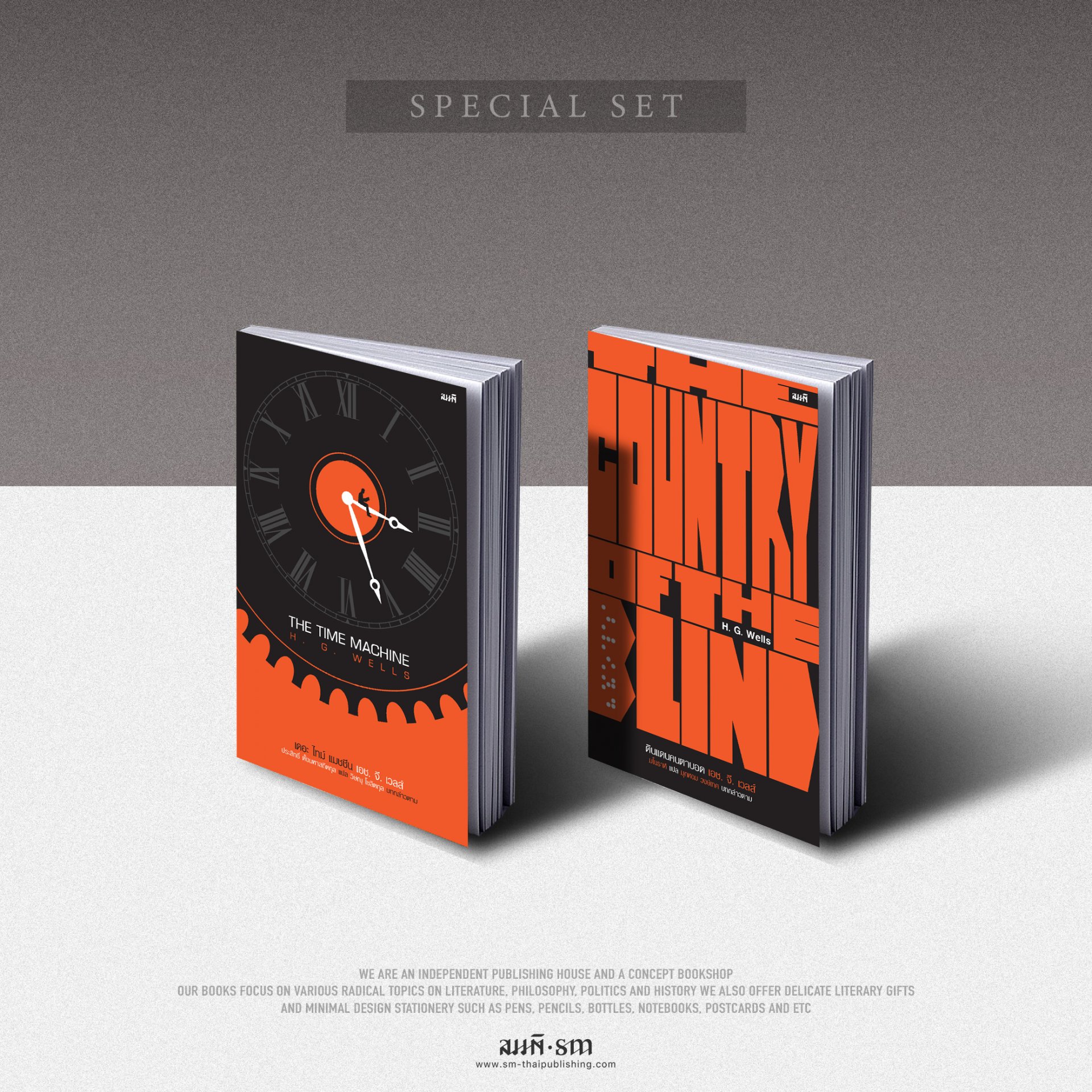
To honor his timeless contributions to world literature, we have beautifully curated and translated two of his most philosophically resonant masterworks for contemporary readers:
The Time Machine (Thai Edition)
and The Country of the Blind (Thai Edition)
— essential volumes for any international institution dedicated to the preservation and study of early modernist genius.
========


11 Feb 2022

26 Sep 2022

3 Apr 2022

16 Sep 2022